WMO-Standard Precipitation Instruments Begin Observations above 4,000 m on the Tibetan Plateau
Precipitation measurements in high-elevation mountains are subject to substantial errors, and observations from different sources lack consistent validation. Estimates of precipitation at high elevations have long been a matter of considerable debate.
To address this problem, a research team led by Dr. Hongyi Li of the Remote Sensing Laboratory, Northwest Institute of Eco-Environment and Resources, Chinese Academy of Sciences, installed WMO-standard wind-shielded precipitation instruments within a snow observation system above 4,000 m in the Qilian Mountains of the northeastern Tibetan Plateau. The aim is to obtain the most accurate precipitation observations possible in environments with high elevations and strong winds.
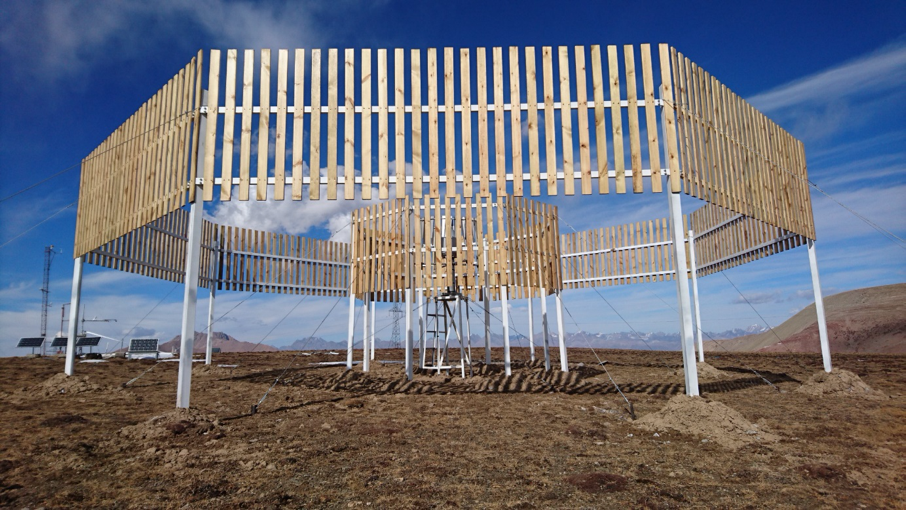
The instrument uses a Double Fence Intercomparison Reference (DFIR) wind shield recommended by the World Meteorological Organization. Two concentric regular octagonal fences made of wooden slats surround a weighing precipitation sensor; the outer fence is taller than the inner fence. Wind affects solid precipitation much more strongly than liquid precipitation. Experiments in China and abroad show that, without any protection around the gauge opening, recorded snowfall is on average 10%–50% lower than the actual amount, with a maximum shortfall of 100%.
This experiment uses the DFIR precipitation gauge recommended by WMO (1985) as the reference gauge. The double fence reduces wind effects on the horizontal collection surface and converts horizontal eddies into vertical eddies, increasing the catch efficiency for solid precipitation and supporting accurate, reliable precipitation measurements.
Together with the existing GMON snow water equivalent instrument and blowing-snow flux instruments in the snow observation system, this installation will improve measurements of snow mass balance and cold-region precipitation.