Improving Gridded Precipitation Data for the Tibetan Plateau
Accurate gridded precipitation information is essential for climate change research, hydrology and water resources studies, and ecological assessment and conservation. Precipitation stations are sparse on the Tibetan Plateau, and measured precipitation is strongly affected by wind and other meteorological conditions, limiting the accuracy of gridded precipitation data. The wide variety of precipitation instruments used across the plateau and surrounding regions also complicates precipitation correction.
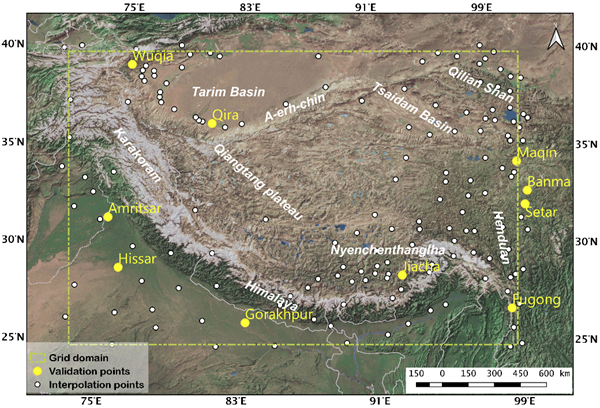
A research team at the Northwest Institute of Eco-Environment and Resources (NIEER), Chinese Academy of Sciences, developed a new gridded precipitation dataset by correcting precipitation losses from different instrument types on the plateau and in neighboring countries and optimizing precipitation frequency distributions in the interpolation scheme. After correcting observation losses, the team compared six commonly used interpolation methods using precipitation frequency error as the evaluation criterion and selected the most suitable method for the Tibetan Plateau. Based on loss-corrected observations from 159 stations (Figure 1), they produced daily gridded precipitation at 10 km resolution for January 1, 1980, through December 31, 2009.
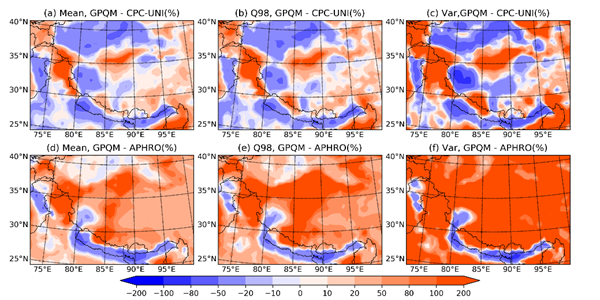
Compared with existing gridded precipitation products, the dataset better represents precipitation frequency distributions, has more reasonable means and variances, and more effectively suppresses the smoothing effect common in gridded precipitation products (Figure 2). It provides more reliable gridded precipitation for Tibetan Plateau hydrometeorological research and a methodological reference for other alpine regions.
The dataset is available through the National Cryosphere Desert Data Center (link) and the National Tibetan Plateau Data Center (link). The associated paper, Reducing the Statistical Distribution Error in Gridded Precipitation Data for the Tibetan Plateau, was published in the Journal of Hydrometeorology.
Jiapei Ma, a master’s graduate of NIEER, is the first author, and Professor Hongyi Li is the corresponding author. The study was jointly supported by the Chinese Academy of Sciences Strategic Priority Research Program, China’s Science and Technology Basic Resources Investigation Program, and the National Natural Science Foundation of China.