Progress in Modeling High-Spectral-Resolution Snow Reflectance for Satellite Observations
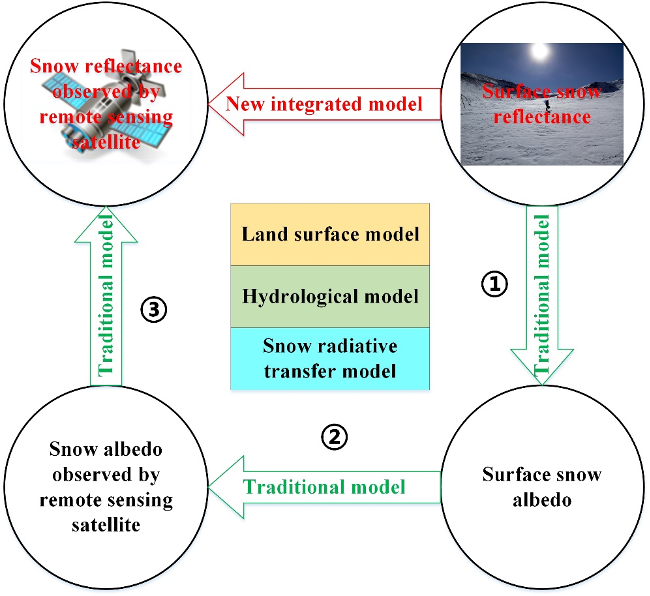
Snow surface spectral reflectance plays an important role in the Earth’s climate system. Conventional parameterized land surface models simulate broadband snow surface albedo but cannot accurately reproduce high-spectral-resolution snow reflectance, which is a primary observable for most current satellite sensors. This creates a clear gap between land surface model simulations and satellite remote sensing observations.
To address this problem, the research group proposed a new integrated model that couples a snow radiative transfer model with a land surface process model to simulate high-spectral-resolution snow surface reflectance for observations from multiple satellites. The results show that the integrated model can accurately simulate continuous time series of snow surface reflectance over large spatial scales. It extends snow spectral reflectance simulations across the full shortwave range and predicts changes in snow reflectance in the solar spectrum from meteorological data. The model also predicts narrowband snow albedo corresponding to MOD09GA data with reasonable accuracy. This represents a major improvement in the direct simulation of satellite observations by conventional land surface models, simplifying several intermediate conversion steps in traditional methods. The integrated approach also helps combine multisource remote sensing observations with land surface process models and substantially advances the use of satellite data in land surface modeling.
Doctoral student Donghang Shao is the first author, and Professor Hongyi Li is the corresponding author. See:
Shao DH, Xu WB, Li HY*, Wang J, Hao XH. Modeling Snow Surface Spectral Reflectance in a Land Surface Model Targeting Satellite Remote Sensing Observations. Remote Sensing, 2020, 12, 3101. https://www.mdpi.com/2072-4292/12/18/3101