Integrated Snow Observations Reveal Frequent Winter Blowing-Snow Events on the Plateau
Professors Hongyi Li and Tao Che and engineer Yang Zhang of the State Key Laboratory of Cryospheric Science and Frozen Soil Engineering, Northwest Institute of Eco-Environment and Resources, Chinese Academy of Sciences, recently published a study in Water Resources Research. Using long-term continuous observations and uncertainty analysis, they revealed the dominant role of wind in winter snow changes at high elevations. The study quantified the contribution of blowing snow to surface snow mass balance from observations and systematically assessed blowing-snow event frequency at different confidence levels, demonstrating quantitatively that blowing snow is a routine winter process on the plateau.
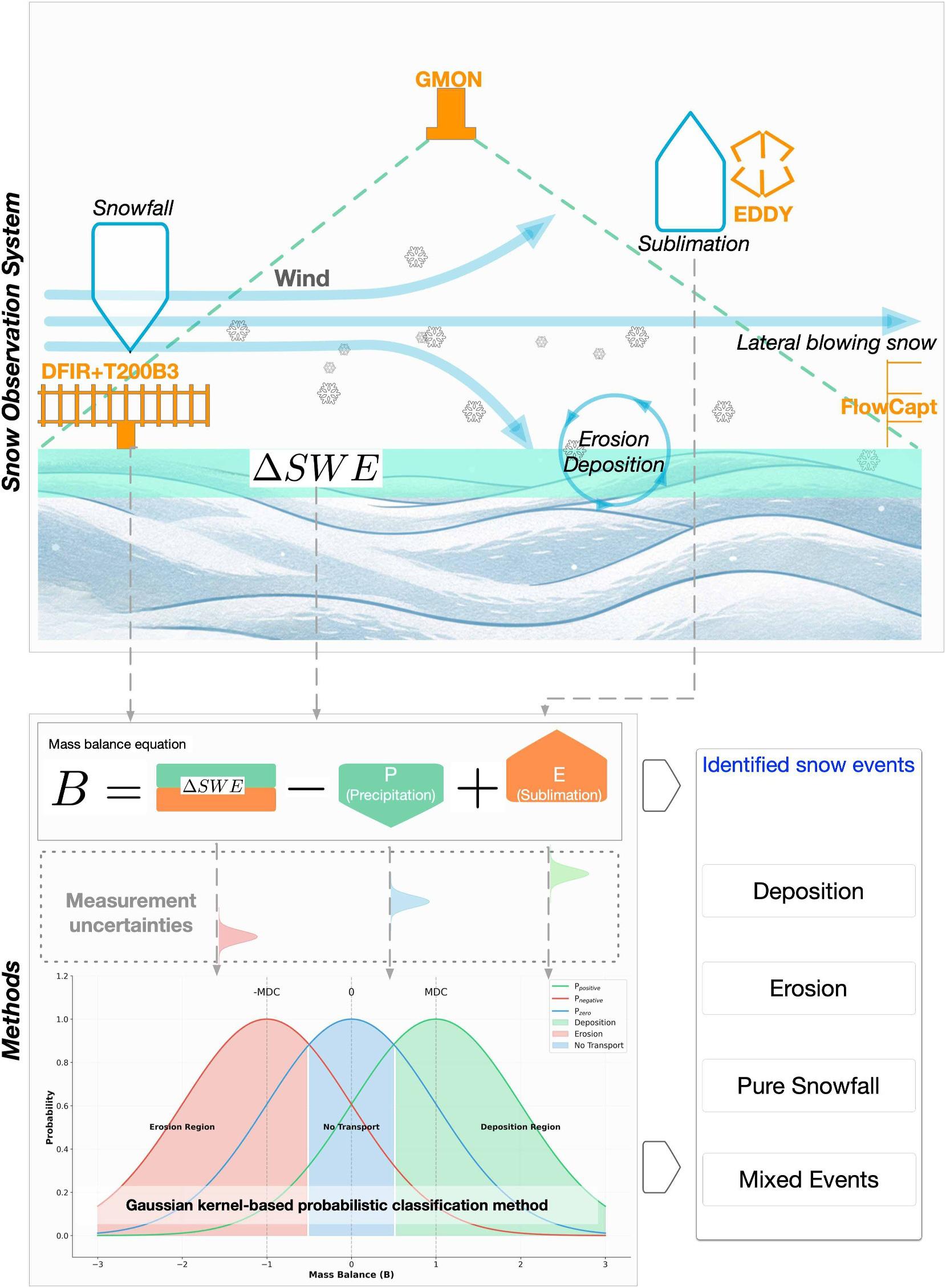
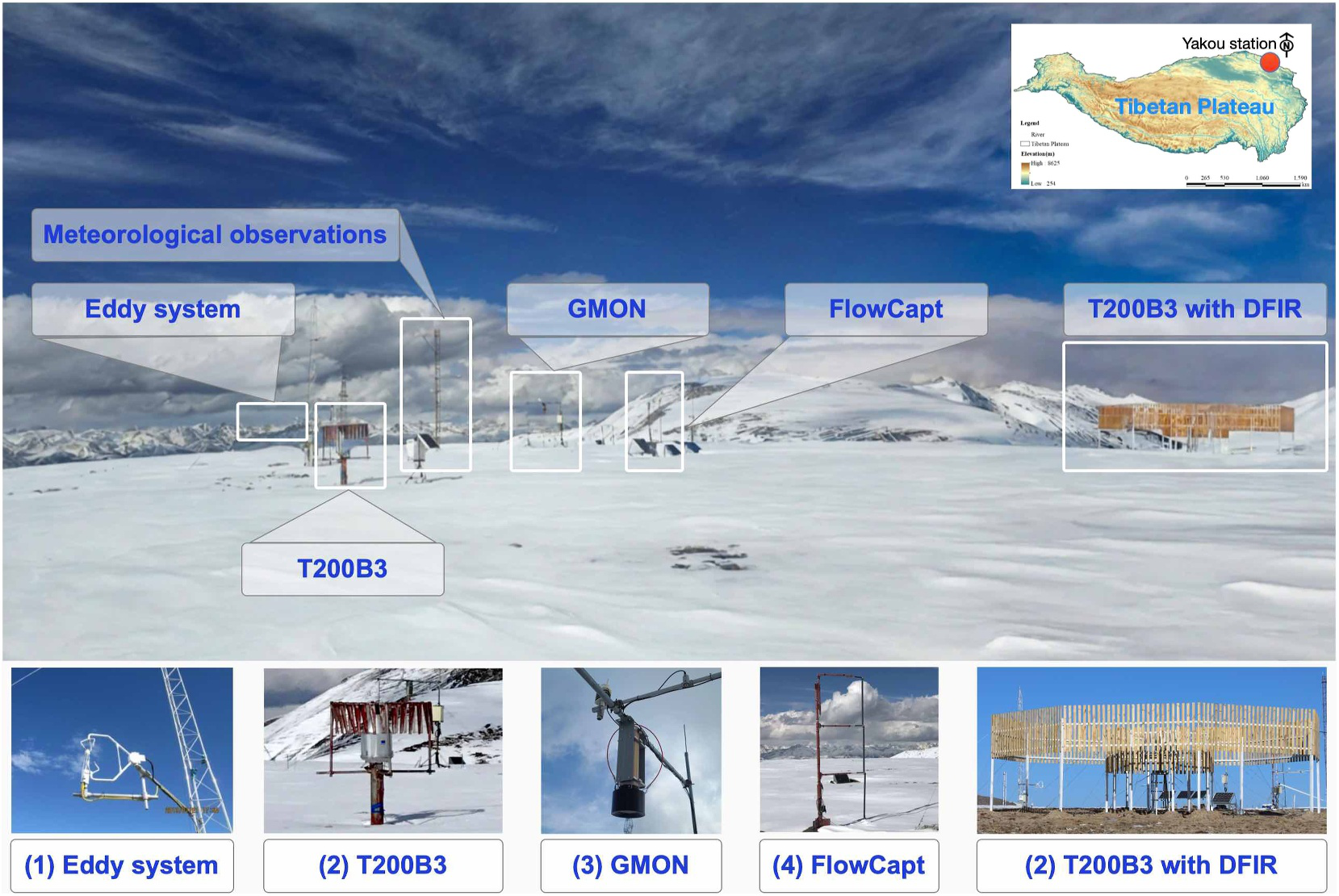
The team established an integrated snow observation system at the Yakou mountain pass, 4,147 m above sea level in the Qilian Mountains of the northeastern Tibetan Plateau. The system measures snowfall using a WMO-standard double-fence shield, snow water equivalent using GMON, blowing-snow transport using Flowcapt acoustic sensors, and sublimation using an eddy-covariance system. A Gaussian-kernel-based probabilistic classification method explicitly incorporated measurement errors from the different instruments to classify each snow-change event and assign confidence levels corresponding to the IPCC terms “Very Likely,” “Likely,” and “About as likely as not.”
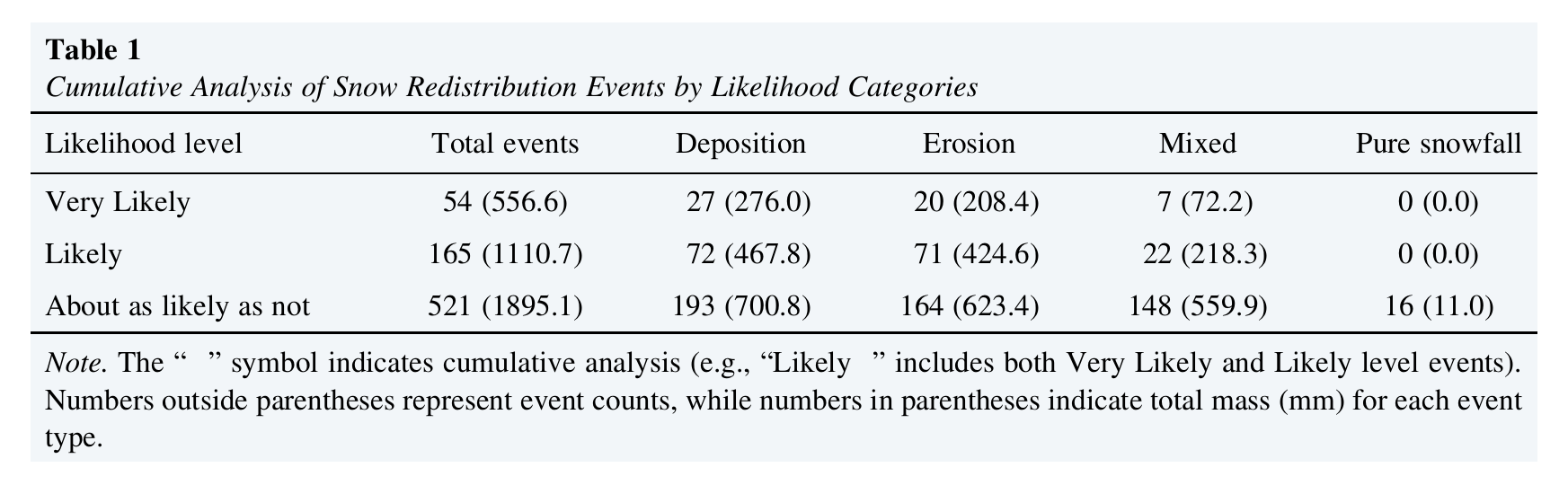
Even under the strictest, highest-confidence criterion (“Very Likely,” probability ≥0.90), many wind-driven snow redistribution events were identified. At this level, blowing-snow deposition and erosion dominated, with almost no snow-change events caused by snowfall alone. When the analysis was extended to the “Likely” and “About as likely as not” confidence levels, wind-driven deposition, erosion, and mixed events consistently accounted for most events, while snowfall-only events remained rare. This consistency across confidence levels shows that blowing snow is a recurring, persistent process that dominates winter snow evolution on the plateau.
Across all confidence levels, wind-driven snow deposition and erosion together accounted for approximately 68.5% of changes in surface snow mass; mixed snowfall and blowing-snow events accounted for 28.4%; and increases caused by snowfall alone accounted for just 3.1%. The study also provided observational evidence that blowing snow enhances sublimation: when wind speeds exceeded approximately 8 m/s, suspended snow particles substantially intensified sublimation. This finding provides high-confidence evidence for improving water resources assessment in alpine regions, where blowing-snow sublimation is often omitted or underestimated in conventional hydrological models.
The study provides observational evidence and a new perspective on the role of blowing snow in the formation of water resources in alpine regions, advancing scientific understanding of snow evolution on the plateau.
Read the full study:
Li, H.*, Che, T., & Zhang, Y. (2025). Wind Shaped Winter Snow Mass Balance at High Altitude: Insights From an Integrated Snow Observation System. Water Resources Research, 61(12), e2025WR039885. https://doi.org/10.1029/2025WR039885
Associated data: Yakou Station Snow Mass Balance and Snow Transport Observations (2014–2017), including six-hourly CSV observation records, access links, and data citations.