
Improving Machine Learning Runoff Simulation under Extreme Hydrological Conditions with Wavelet-Based Abnormality Recognition
As extreme climatic and hydrological events become more frequent, improving the performance of data-driven hydrological models under anomalous conditions has become an important research challenge. Conventional machine learning methods can perform well during stable periods, but often fail during sudden droughts, intense rainfall, or abrupt changes in runoff. One underlying reason is the low proportion of anomalous samples in training datasets, which limits the models’ ability to learn these conditions specifically.
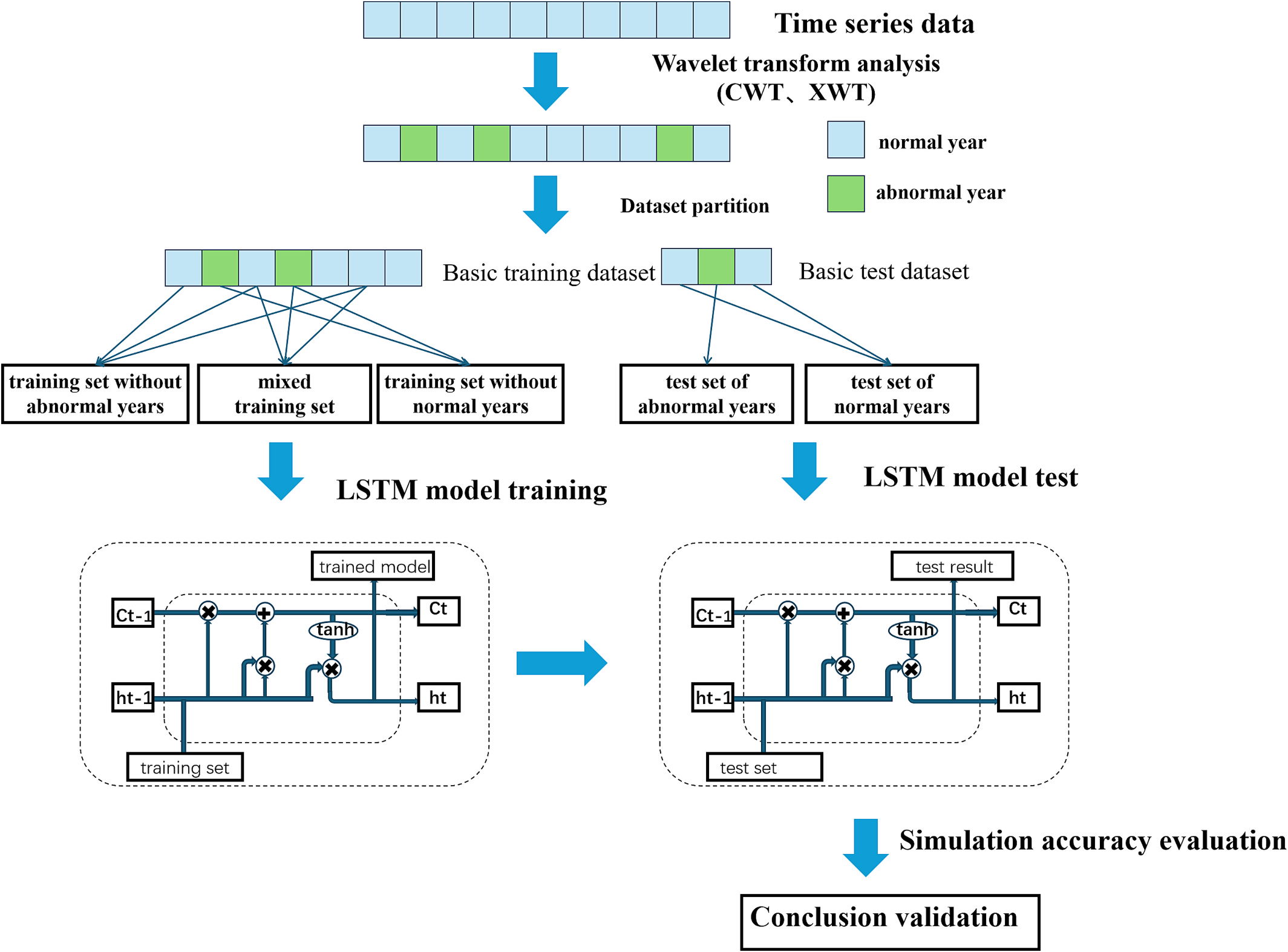
In a recent study published in the Journal of Hydrology, the team proposed a wavelet-based abnormality pattern recognition method to improve dataset construction for machine learning runoff simulation. Using the Heihe River basin as a case study, the researchers combined continuous wavelet transform (CWT) and cross-wavelet transform (XWT) to analyze multiscale time–frequency relationships between meteorological variables and runoff. They identified anomalous features in different periods and reorganized model training samples accordingly, giving data-driven hydrological models the potential to handle a range of extreme hydrological conditions.
Previous improvements largely focused on model structure. This study instead began with training-data quality, distinguishing normal and anomalous periods through fluctuation patterns so that models could learn runoff responses under different climatic conditions. The results show that increasing the proportion of anomalous samples can substantially improve prediction accuracy during extreme events.
This work offers a new approach to machine learning hydrological simulation: improving generalization through data-feature identification and stratified training, rather than relying solely on more complex models or larger datasets. It provides a data-based route to more robust machine learning schemes for catchment simulation under extreme hydrometeorological conditions.
Publication
Liu, Yiwei, Li, Hongyi*, Yang, Yaru, Pang, Xin, & Niu, Liting (2025). Enhancing machine learning runoff simulation via wavelet-based abnormality pattern recognition. Journal of Hydrology, 661, 133729. https://doi.org/10.1016/j.jhydrol.2025.133729